
News
FAMFA Oil Faces ₦8.85bn Customs Duty Dispute Over Private Jet Fleet, Court Case Reveals Decade-Long Importation Questions


By Staff Reporter Miracle
IduwiniVoiceTv investigation has uncovered a long-running customs dispute involving FAMFA Oil Limited and three Bombardier private jets linked to the company, with federal authorities demanding approximately ₦8.85 billion in import duty on one of the aircraft, TrackNews Online reported.
The dispute, which is now before the courts, centres on allegations that the aircraft remained in Nigeria beyond the permitted period for temporary importation and that required customs documentation was either obtained late, overstayed or, in the case of one aircraft, allegedly not obtained at all.
The three aircraft identified in the records are a Bombardier Global 6000 XRS, registration VP-CFO; Bombardier Global 6000, registration VP-CEO; and Bombardier Global 7500, registration VP-CTO.
Together, the aircraft represent a substantial private aviation fleet, with the Global 7500 alone having a new list price of about $75 million.
Customs verification brings fleet under scrutiny
The controversy emerged from nationwide verification exercises initiated by the Nigeria Customs Service to identify privately owned aircraft operating in the country without properly regularised importation status.
The exercises, conducted initially in 2021 and subsequently expanded in 2024, involved cross-checking aircraft ownership information, Temporary Importation Permits (TIPs) and aviation clearance documents against aircraft operating in Nigeria.
Records reviewed by TrackNews Online indicate that the three FAMFA Oil-linked aircraft were among those flagged by federal authorities.
The most significant financial assessment concerns the Bombardier Global 7500, VP-CTO, for which customs authorities reportedly assessed an outstanding duty of ₦8,849,869,111.
Global 6000: Aircraft allegedly remained beyond TIP period
Documents examined in the course of the investigation indicate that the Bombardier Global 6000, registered VP-CEO, arrived in Nigeria in 2012 and underwent post-arrival customs inspection in September of that year.
An import permit was reportedly issued in August 2012.
Under the applicable Temporary Importation Permit regime, the permitted period is subject to a maximum duration after which an aircraft must either be exported or regularised through permanent importation and payment of the applicable duties and taxes.
According to the records reviewed, the aircraft remained in Nigeria and continued to operate beyond the permitted period, without evidence in the documents examined of a completed permanent conversion or formal exportation.
Second jet allegedly obtained permit after arrival
The circumstances surrounding the Global 6000 XRS, VP-CFO, also raise questions about the timing of its customs documentation.
The aircraft reportedly underwent post-arrival inspection in July 2015, while its Temporary Importation Permit was obtained in February 2016—approximately seven months later.
Customs records cited in the dispute reportedly describe the subsequent regularisation as an attempt to address the aircraft’s status after its arrival.
The aircraft also allegedly remained in Nigeria beyond the period permitted under the temporary importation arrangement.
Global 7500 and ₦8.85bn assessment
The newest aircraft in the fleet, the Bombardier Global 7500, VP-CTO, arrived in Nigeria on December 6, 2023.
According to the records examined, customs authorities found no evidence of a Temporary Importation Permit having been obtained for the aircraft during the relevant period.
The absence of the required customs documentation became central to the government’s assessment of approximately ₦8.85 billion in import duty against the aircraft.
The matter has subsequently become the subject of legal proceedings.
Did international flights amount to exportation?
One of the central issues in the dispute is whether international flights made by the aircraft could be treated as evidence that the jets had been exported from Nigeria.
Investigative findings indicate that the authorities’ position is that ordinary flights to destinations outside Nigeria do not, by themselves, constitute permanent customs exportation.
Under that interpretation, an aircraft temporarily leaving Nigeria for a business or private flight and subsequently returning remains subject to the country’s customs requirements unless the appropriate export procedures have been completed.
Records reviewed by IduwiniVoiceTV reportedly show no evidence that FAMFA Oil obtained permanent export approvals, Bills of Exit or Certificates of Exportation for the three aircraft at the relevant stages.
Aviation certificates add another layer
Another important element of the dispute concerns aviation documentation.
The three aircraft reportedly continued to have operational and maintenance clearance documentation issued by the Nigeria Civil Aviation Authority during the period under review.
The government’s position, as reflected in the dispute, is that continued Nigerian aviation certification is inconsistent with the argument that the aircraft had been permanently exported from the country.
This distinction between temporary international movement and formal customs exportation is expected to be one of the issues considered in the ongoing court proceedings.
Questions surrounding a major oil company
FAMFA Oil is associated with billionaire businesswoman Folorunso Alakija and has interests in Nigeria’s oil and gas industry, including an interest connected to the Agbami deepwater field.
The customs controversy therefore raises questions not only about the company’s private aviation operations but also about compliance with Nigeria’s import and tax regulations by high-value corporate operators.
For ordinary importers, failure to comply with customs procedures can result in significant financial liabilities. The current dispute will determine whether the same rules were breached in relation to FAMFA Oil’s aircraft and, ultimately, whether the government’s assessment is legally sustainable.
What happens next?
The federal government’s case now faces judicial scrutiny.
At the heart of the dispute are questions over the validity and timing of the aircrafts’ Temporary Importation Permits, the duration of their stay in Nigeria, whether the jets were properly exported at any point, and whether the ₦8.85 billion customs assessment against the Global 7500 is legally justified.
Until the court determines the matter, the allegations remain contested.
IduwiniVoiceTV understands that the case could have wider implications for private aircraft owners and operators in Nigeria, particularly regarding the enforcement of Temporary Importation Permits and the distinction between international flight operations and formal customs exportation.
IduwiniVoiceTV will continue to follow the proceedings and report developments as they emerge.


By staff Reporter Rukevwe Odeh
Residents and road users along the Warri Airport Road, particularly the section near Federal Government College in Warri South Local Government Area of Delta State, have continued to contend with recurring flooding despite years of road construction and rehabilitation efforts.
The affected stretch is frequently submerged following heavy rainfall, with inadequate drainage identified as a major factor contributing to the persistent flooding.
The recurring situation has raised concerns among motorists, residents and other road users, who say the condition of the road continues to disrupt movement and create difficulties for commuters whenever there is significant rainfall.
The development has also renewed calls for attention to the drainage system along the route, with residents hoping that a lasting solution will be implemented to prevent the road from repeatedly becoming flooded.
By staff Reporter: Rukevwe Odeh
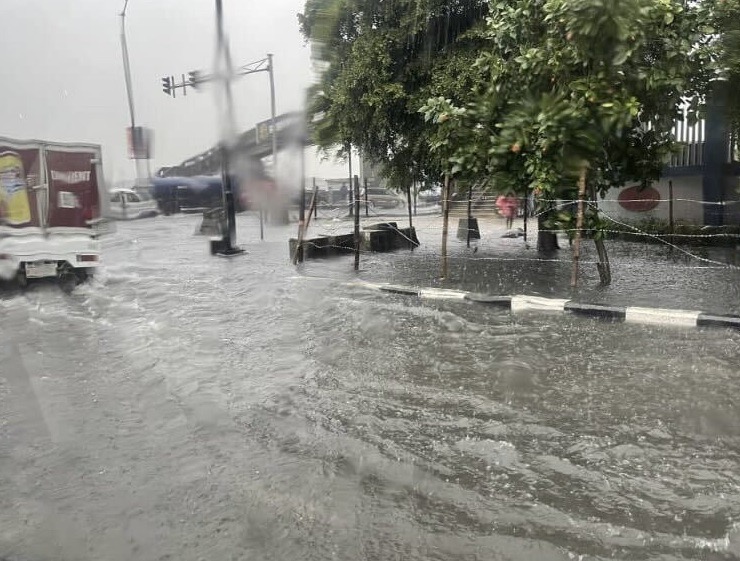
A heavy downpour has left the popular NNPC Housing Complex Road, also known as Ekpan Link Road, submerged in floodwater in Uvwie Local Government Area of Delta State.
The rainfall caused significant water accumulation along the busy road, affecting movement and creating difficulties for motorists and other road users.
The condition of the road has renewed concerns over flooding and drainage challenges in the area, particularly during periods of heavy rainfall.
Residents and commuters are expected to exercise caution while using the affected route as efforts to manage the situation continue.
By Staff Reporter: Rukevwe Odeh
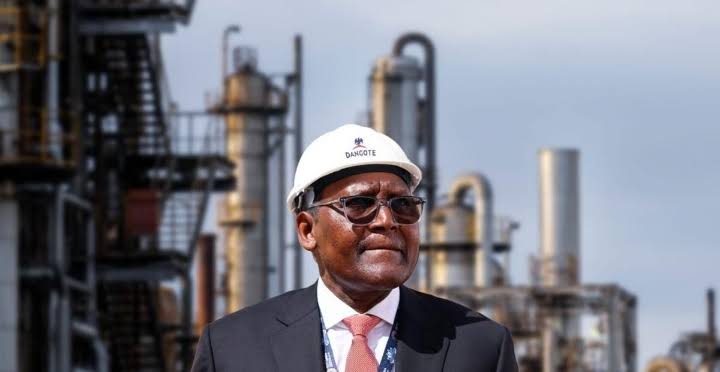
Dangote Industries Limited has acquired an additional 4,000 construction machines as part of its ongoing expansion of the Dangote Petroleum Refinery in Lagos.
The latest procurement has increased the company’s construction equipment fleet to approximately 6,500 units, including 330 cranes, as the group works to raise the refinery’s planned processing capacity from 650,000 barrels of crude oil per day to 1.4 million barrels per day.
The Group Vice President, Oil and Gas and Fertiliser, Devakumar Edwin, disclosed this during a briefing with editors following a tour of the refinery in Ibeju-Lekki, Lagos.
Edwin explained that Dangote initially acquired 2,563 pieces of construction equipment after some contractors indicated that they lacked the capacity required to handle the refinery’s major factory structures.
He said the group subsequently decided to build its own substantial equipment fleet rather than depend entirely on foreign engineering, procurement and construction contractors.
According to him, bringing foreign contractors and their machinery into Nigeria would have involved additional mobilisation and demobilisation expenses, with equipment depreciation potentially increasing the overall project cost.
Edwin said the company’s approach was also influenced by the limited availability of heavy construction equipment in Nigeria.
He recalled that when Dangote constructed its Apapa sugar refinery in 1998, only two large cranes with a lifting capacity of about 150 tonnes were available in the country.
For the Lekki refinery project, Dangote has since developed a much larger equipment base, including 330 cranes, to support construction activities.
The executive also disclosed that a significant portion of the infrastructure established during the first phase of the refinery would be reused for the expansion.
These facilities include a granite quarry with a stated capacity of 10 million tonnes, 82 concrete batching plants, 203 transit mixers, a private port, an oxygen and welding-gas plant and accommodation facilities capable of housing up to 50,000 workers.
Edwin further revealed that the refinery, originally designed for 650,000 barrels per day, was operating at about 700,000 barrels per day at the time of the briefing.
He said Dangote also opted to execute the expansion through its own project company after international contractors reportedly proposed fees amounting to about 12.5 per cent of an estimated $19.5 billion project cost.
That figure, according to Edwin, would have translated into approximately $2.5 billion in contractor fees.
Instead, Dangote Projects Limited was tasked with handling detailed engineering, procurement and the coordination of contractors involved in the project.
The refinery was designed to serve both the Nigerian market and international customers, with the company previously indicating that part of its output would be allocated to domestic consumption while the remainder would be exported.
The planned expansion to 1.4 million barrels per day is expected to significantly increase the refinery’s production capacity and strengthen Dangote Industries’ refining operations.
Edwin also said the group’s overall refining capacity could eventually rise to about 2.1 million barrels per day when the Lekki expansion is combined with the planned 700,000-barrel-per-day refinery project in Kenya.
The Dangote refinery is currently described by the company as the world’s largest single-train petroleum refinery.
-

 Social2 months ago
NAIS – Northern Nigeria/Abuja Chapter Honours Amb. Ebi Lagos with Award of Recognition
-
 Breaking3 months ago
2027: INEC Alegedly Announces Plans to Conduct Party Primaries in the Newly Created State Constituencies in Warri North and Warri Southwest LGAs, Others
-

 News1 month ago
PAP: EX-AGITATORS OF BOYLOAF CAMP DISTANCE SELVES FROM THEIR LEADERS ONSLAUGHT ON THE PAP ADMINISTRATOR
-

 Local News4 months ago
Just In: Ambassador Podoki Emerges APP Candidate for Burutu Constituency-I Assembly Seat
-
 Politics3 months ago
2027: Mulade Challenges NDC’s Substitution of His Party Candidacy, Demands ₦5 Billion Damages
-
 Breaking3 months ago
Tinubu Intervenes in Warri Delineation Dispute, Meets Ijaw, Urhobo and Itsekiri Leaders
-

 Local News4 months ago
INC: Group Faults Sponsored Attacks on Tompolo, Igbadiwei, Urges Unity in Ijaw Nation
-
 Entertainment2 months ago
JKing Logistics Coordinator Shed Light to Address Ijaw Music Wage Controversy