
News
TORUGBENE–OJOBO ROAD: EIGHT YEARS OF PROMISES, BILLIONS OF NAIRA, AND THE LONG ROAD TO REALITY


By staff Miracle Orumor
“The money trail, the missing links, and the questions Delta State must answer”
Engr. Henry Yeigagha, JP,
M.ENG, MNSE, MNIM, COREN, FHNR, A.D.Th, writes from Ayakoromo Town, Burutu Local Government Area of Delta State.
There are roads that merely connect communities, and there are roads that can redefine the destiny of an entire people. The Torugbene–Ojobo Road belongs to the latter. For the riverine communities of Burutu Local Government Area, it is more than asphalt and bridges; it is a potential economic artery, a route to education and healthcare, and a long-awaited escape from geographical isolation. Yet, after years of budgets, contracts, and promises, the project remains a story demanding serious public examination.
THE LONG BEGINNING
The documentary trail takes the project back to 2018, when the Delta State Government’s approved budget provided for the construction of the Torugbene–Ojobo Road. By 2019, it had been defined as Torugbene/Ojobo Road, Section A, measuring 3.104 kilometres from the end of an NDDC project to the approach of the first bridge.
That history raises legitimate questions: What exactly was constructed? What was the original contract sum? What was eventually paid? Were variations approved? Where did the NDDC intervention end, and where did the Delta State intervention begin? These are not accusations; they are legitimate questions of public infrastructure accountability.
THE 2022 PROMISE AND THE 2025 PROTEST
According to the Ojobo Development Forum, the Torugbene–Ojobo project appeared in the 2022 Delta State Budget but was reportedly not implemented. By March 2025, community frustration had resulted in public protest following the project’s reported removal from the 2025 budget. The community cited an estimated 13.205-kilometre road and demanded its reinstatement.
The protest represented more than a demand for asphalt. It reflected the frustration of communities that remain economically productive but physically disconnected. The fundamental question is simple: How can riverine communities participate meaningfully in the State’s economy when basic transportation infrastructure remains inadequate?
2026: THE ROAD RETURNS
The narrative changed in 2026, when the Delta State Government approved a new intervention on the Torugbene–Ojobo corridor. The project was welcomed by residents and stakeholders as a significant development for the riverine area.
The Delta State Public Procurement Commission officially describes it as “Completion of the Construction of Torugbene–Ojobo road (phase II), Section B: From the End of Section 1 to Ojobo.” The documented length is 9,463 metres, with an average clearance width of 13 metres, pavement width of 10 metres, and a 30-metre bridge.
Its scope includes site clearance, removal of unsuitable materials, sharp-sand filling, crushed-stone base, drainage, road-base reinforcement, and asphalt surfacing. It is therefore designed as a substantial engineered road, not merely a temporary access track.
THE ₦32.888 BILLION QUESTION
The financial dimension is perhaps the most striking aspect of the new intervention. Current project reporting places the value of the Torugbene–Ojobo Phase II project at approximately ₦32.888 billion. For a documented road length of 9.463 kilometres, that headline figure naturally invites public scrutiny.
On simple arithmetic, ₦32.888 billion divided by 9.463 kilometres produces an apparent average of approximately ₦3.48 billion per kilometre. But engineering economics cannot be judged by that calculation alone. Riverine construction involves difficult terrain, extensive earthworks, sand filling, drainage, bridge construction, marine logistics, equipment mobilisation, and other costs that can substantially affect the unit rate.
Nevertheless, a project of nearly ₦33 billion deserves full transparency. The public should, therefore, have access to the Bill of Quantities, contract award, payment schedule, variation provisions, and completion certification.
THE LENGTH PARADOX
Another issue requiring clarification is the project’s reported length. The historical Section A is documented as 3.104 kilometres, while the current Section B is 9.463 kilometres. Together, they total 12.567 kilometres.
Yet the Ojobo Development Forum previously referred to the corridor as approximately 13.205 kilometres, leaving a difference of about 638 metres. This does not establish wrongdoing; different chainage points, alignments, bridge approaches, terminal points, or existing NDDC works could explain the discrepancy.
But with almost ₦33 billion now involved, the public deserves a definitive engineering schedule showing exactly where the road begins, where it ends, what has already been constructed, and what the new contract covers.
THE NDDC CONNECTION
The project’s history also reveals an important NDDC connection. The earlier Delta State description of Section A referred specifically to the point where an NDDC project ended. Therefore, the entire Torugbene–Ojobo corridor should not be treated as one uninterrupted contract.
There is a need for a clear project genealogy: NDDC Section – Delta State Section A – Phase II Section B – Ojobo. Such documentation would eliminate confusion over responsibility, funding, completed works, and outstanding sections.
SETRACO AND THE CONTRACTOR QUESTION
The contractor identified for the current project is Setraco Nigeria Limited. The official procurement record gives the project a 24-month contract period, with an expected completion date of 7 April 2028.
This creates a measurable public benchmark. From now until completion, progress should be assessed not by political announcements but by physical quantities: metres cleared, earthworks completed, drainage constructed, bridge works executed, pavement layers completed and kilometres asphalted.
THE ZERO PER CENT DILEMMA
The Delta State project-monitoring platform currently displays 0 per cent progress for the project. This should be interpreted cautiously because monitoring platforms may not immediately reflect mobilisation or newly certified physical work.
Nevertheless, the figure represents the State’s publicly accessible monitoring position. If physical mobilisation has commenced, the monitoring record should be updated promptly. If substantial work has not commenced, the public deserves to know why.
THE MISSING EIGHT KILOMETRES
The wider connectivity challenge may be even more important. The Torugbene–Ojobo road cannot achieve its full economic value if the preceding links remain inaccessible.
Recent advocacy has drawn attention to an approximately eight-kilometre stretch between Bomadi and the beginning of the Torugbene–Ojobo project. This highlights a fundamental infrastructure principle: roads function as networks, not isolated kilometres.
A beautifully constructed nine-kilometre road cannot deliver its full economic benefit if an impassable stretch interrupts the journey immediately before it. The ultimate objective should, therefore, be a continuous Bomadi–Tuomo–Tamigbe–Torugbene–Ojobo corridor.
WHY THE ROAD MATTERS
For communities along this corridor, road connectivity could transform everyday life. Fishermen could move their catch more efficiently; farmers could reach markets; students could access schools; patients could reach healthcare facilities; businesses could transport goods; and government agencies could reach communities more effectively.
The road, therefore, represents more than transportation infrastructure. Properly executed, it could become an economic and social development corridor for a historically underserved part of the Niger Delta.
THE ENGINEERING TEST
As an engineer, I believe the project must be judged not merely by commissioning photographs but by its ability to survive the environment. The Niger Delta presents serious engineering challenges, including soft and compressible soils, flooding, erosion, high groundwater, and difficult logistics.
The embankment must be stable; drainage must be adequate; bridge approaches must be properly integrated; pavement layers must meet specification; compaction must be verified; and materials must satisfy the required standards. A road that looks impressive at commissioning but deteriorates shortly afterwards cannot be described as successful infrastructure.
TWELVE QUESTIONS DELTA STATE SHOULD ANSWER
For transparency, the following questions deserve clear documentary answers:
▪︎ What is the complete original alignment and chainage of the Torugbene–Ojobo Road?
▪︎ What exactly was constructed under Section A?
▪︎ What was the final cost of Section A?
▪︎ What variations were approved on the earlier sections?
▪︎ What exactly does the current ₦32.888 billion commitment cover?
▪︎ Does it include bridges, approaches, drainage and ancillary works beyond the 9.463-kilometre road?
▪︎ Why does the official measurement state 9.463 kilometres while the community previously cited 13.205 kilometres?
▪︎ What is the precise relationship between the NDDC and Delta State sections?
▪︎ What percentage of the current contract sum has been paid?
▪︎ What is the independently verified physical progress?
▪︎ Who is responsible for independent engineering supervision and certification?
▪︎ What is being done to ensure that the project ultimately connects with the Bomadi–Torugbene corridor?
These questions are not hostile. They are the normal questions that should accompany a major public infrastructure investment.
FROM BUDGET LINE TO CONCRETE REALITY
The people of Torugbene and Ojobo have waited long enough. They have seen budget provisions, announcements, omissions, protests, and renewed promises. What they now deserve is a transparent construction process through which every phase, quantity, payment, and milestone can be independently followed.
The ₦32.888 billion commitment represents a significant investment. Properly executed, the project could become one of the defining riverine infrastructure achievements of the present administration. But if delays and uncertainty return, another generation may inherit the same unanswered question: When will our road finally become a road?
THE ROAD MUST NOT END ON PAPER
The Torugbene–Ojobo Road is now at a decisive point. The project has been approved, formally defined, assigned to a contractor, and given a completion target of 2028. The next responsibility is to ensure that the project moves from documentation to physical reality.
The people of the riverine communities deserve a road whose beginning and end can be physically identified, whose specifications can be independently verified, whose cost can be reconciled with its quantities and whose completion certificate means genuine completion.
The road must, therefore, move from budget to ground, from ground to asphalt, and from asphalt to sustainable public use.
For the people of Torugbene and Ojobo, the real groundbreaking ceremony will not be the one attended by dignitaries. It will be the day an ordinary fisherman, farmer, trader, student, civil servant, or patient travels safely from Torugbene to Ojobo by road and knows that the road is finally there to stay. That is when an allocation becomes development. That is when a promise becomes history.

By staff Reporter Rukevwe Odeh
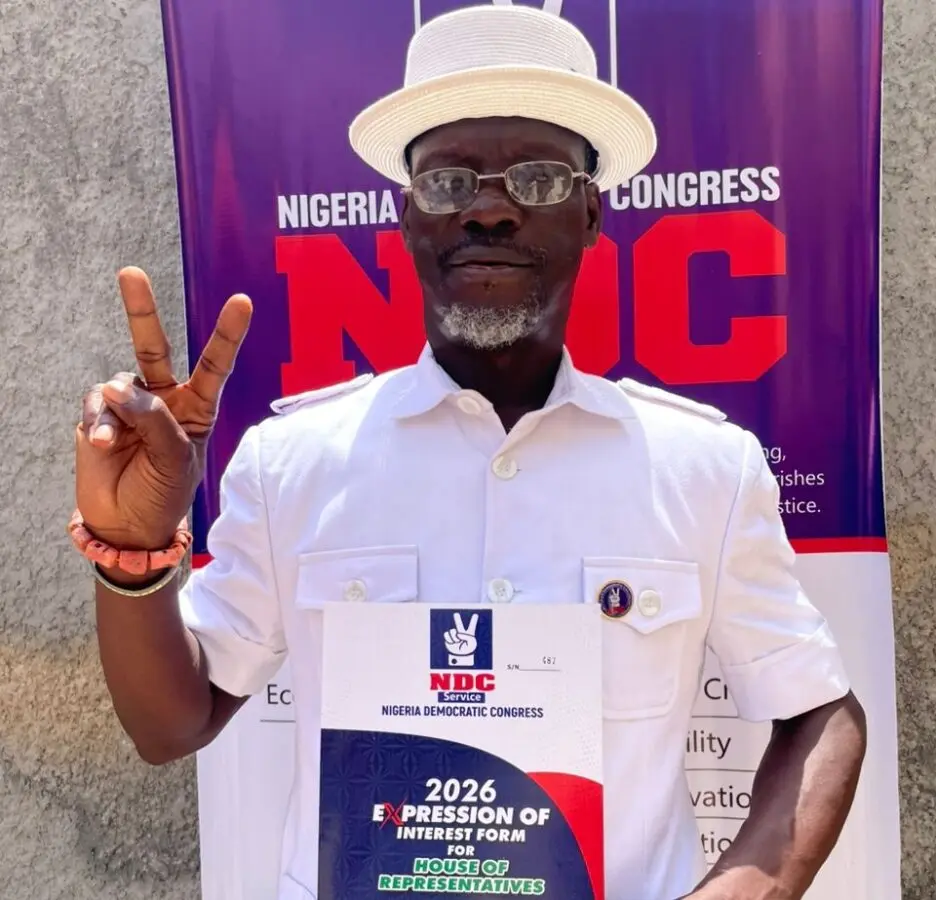
A group of stakeholders in Warri has announced its decision to withdraw support for the incumbent member representing the Warri Federal Constituency in the House of Representatives, Hon. Thomas Ereyitomi, ahead of the 2027 general elections.
The group, while explaining its position, cited what it described as dissatisfaction with the lawmaker’s performance and representation of the constituency.
The stakeholders subsequently declared their support for Comrade Jude Ukori Mulade as their preferred candidate for the 2027 House of Representatives election.
According to the group, its decision followed concerns over the level of representation and development delivered to the constituency under the current administration.
The stakeholders said they were seeking a representative who would be more responsive to the needs of the people and more committed to advancing issues affecting residents across the constituency.
They urged other political stakeholders and eligible voters in Warri to consider Mulade’s candidacy as the 2027 elections approach.
The group’s endorsement adds to the growing political activities and realignments expected to shape the contest for the Warri Federal Constituency seat ahead of the 2027 general elections.
Ereyitomi, who currently represents the constituency in the House of Representatives, has yet to publicly respond to the allegations contained in the group’s statement.
By staff Reporter Rukevwe Odeh
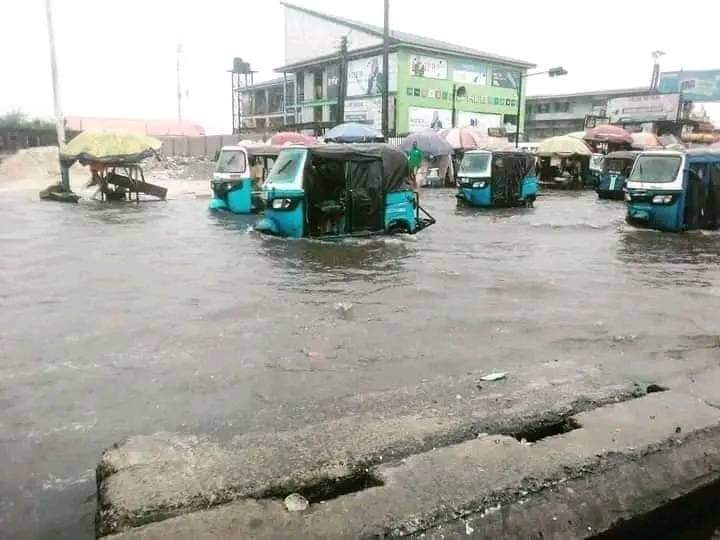
Residents and road users along the Warri Airport Road, particularly the section near Federal Government College in Warri South Local Government Area of Delta State, have continued to contend with recurring flooding despite years of road construction and rehabilitation efforts.
The affected stretch is frequently submerged following heavy rainfall, with inadequate drainage identified as a major factor contributing to the persistent flooding.
The recurring situation has raised concerns among motorists, residents and other road users, who say the condition of the road continues to disrupt movement and create difficulties for commuters whenever there is significant rainfall.
The development has also renewed calls for attention to the drainage system along the route, with residents hoping that a lasting solution will be implemented to prevent the road from repeatedly becoming flooded.
By staff Reporter: Rukevwe Odeh
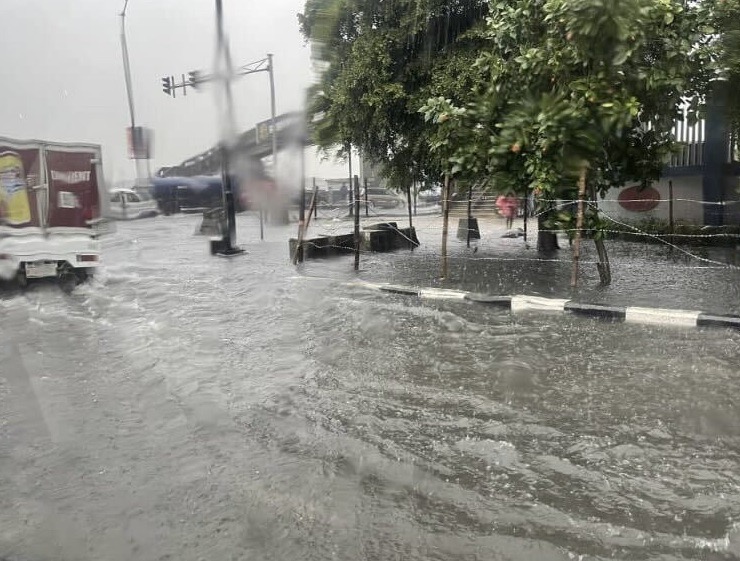
A heavy downpour has left the popular NNPC Housing Complex Road, also known as Ekpan Link Road, submerged in floodwater in Uvwie Local Government Area of Delta State.
The rainfall caused significant water accumulation along the busy road, affecting movement and creating difficulties for motorists and other road users.
The condition of the road has renewed concerns over flooding and drainage challenges in the area, particularly during periods of heavy rainfall.
Residents and commuters are expected to exercise caution while using the affected route as efforts to manage the situation continue.
-

 Social2 months ago
NAIS – Northern Nigeria/Abuja Chapter Honours Amb. Ebi Lagos with Award of Recognition
-
 Breaking3 months ago
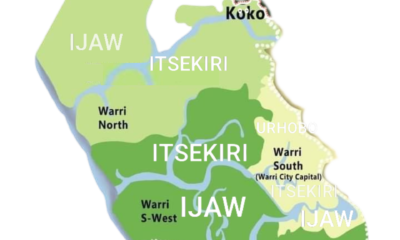
2027: INEC Alegedly Announces Plans to Conduct Party Primaries in the Newly Created State Constituencies in Warri North and Warri Southwest LGAs, Others
-

 News1 month ago
PAP: EX-AGITATORS OF BOYLOAF CAMP DISTANCE SELVES FROM THEIR LEADERS ONSLAUGHT ON THE PAP ADMINISTRATOR
-

 Local News4 months ago
Just In: Ambassador Podoki Emerges APP Candidate for Burutu Constituency-I Assembly Seat
-
 Politics3 months ago
2027: Mulade Challenges NDC’s Substitution of His Party Candidacy, Demands ₦5 Billion Damages
-
 Breaking3 months ago
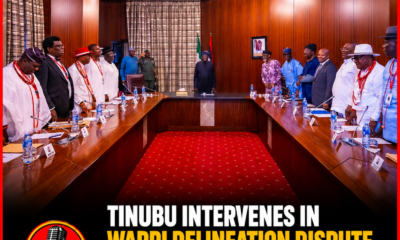
Tinubu Intervenes in Warri Delineation Dispute, Meets Ijaw, Urhobo and Itsekiri Leaders
-

 Local News4 months ago
INC: Group Faults Sponsored Attacks on Tompolo, Igbadiwei, Urges Unity in Ijaw Nation
-

 Entertainment2 months ago
JKing Logistics Coordinator Shed Light to Address Ijaw Music Wage Controversy