
News
OTUARO AND THE ARCHITECTURE OF NIGER DELTA RENEWAL


By Staff Reporter Miracle Orumor
In a region where the vocabulary of development has too often been reduced to roads, contracts, compensation, and political appointments, Dr. Dennis Brutu Otuaro is introducing another vocabulary: the vocabulary of human capital, intellectual mobility, and generational transformation. The latest departure of 31 Presidential Amnesty Programme scholarship beneficiaries for postgraduate studies in the United Kingdom is, therefore, more than a ceremonial event; it is another brick in the architecture of Niger Delta renewal.
The figures themselves deserve attention: With this latest batch, 243 PAP-sponsored postgraduate scholars have been deployed overseas in 2026. Behind the number are 243 individual journeys, families watching their sons and daughters cross international borders in pursuit of advanced knowledge, and potentially 243 future professionals whose expertise could eventually find expression in the development challenges of the Niger Delta and Nigeria.
More significant is the intellectual diversity of the disciplines involved, ranging from construction engineering management, oil and gas engineering and software engineering to cybersecurity, data science analytics, fintech analytics, law, forensic audit and global public health. These are not ornamental qualifications but fields through which a resource-rich yet development-challenged region can convert human potential into institutional capacity.
Otuaro’s emphasis on academic excellence is equally important because a scholarship is not merely a ticket to another country; it is a public investment carrying an obligation. By urging beneficiaries to distinguish themselves academically, obey the laws of their host institutions and return with knowledge that can benefit their communities, he has framed the opportunity as more than personal advancement; it becomes a covenant between the beneficiary and the society that made the opportunity possible.
There is something particularly significant about this approach in the Niger Delta, where development conversations have for decades been dominated by resource control, environmental concerns, and infrastructural deficits. No region, however resource-endowed, can permanently build its future upon natural resources alone; oil beneath the soil may finance development, but knowledge inside the human mind sustains it.
That is why the idea of building a “community of intellectuals” deserves serious attention. Such a community is not merely a collection of people holding foreign degrees; it is a reservoir of specialised knowledge capable of confronting local problems with global competence, whether through engineering, data science, cybersecurity, public health, law, finance or other fields essential to a modern economy.
In that sense, the ultimate destination of these scholars should not be London, Manchester, or any other foreign academic centre; their ultimate destination should be useful. The degree is only the vessel, and the knowledge is the cargo, but that cargo must eventually find its way back to the communities and country from which the opportunity emerged.
This is where Otuaro’s intervention assumes a significance larger than the administrative machinery of PAP because sustainable peace is not secured merely by disarming young people or providing temporary economic opportunities. It is strengthened when young people acquire the intellectual capacity to participate meaningfully in the economy, institutions, and governance of their society, giving them tools with which to negotiate their future beyond the vocabulary of grievance.
The deeper beauty of such an investment is that its harvest cannot be confined to one administration, since a road may deteriorate, a political office may change hands and a contract may expire, but knowledge, once genuinely acquired, can reproduce itself across generations. One scholar can become an expert, an expert can establish an institution, and an institution can train another generation, giving education a multiplier effect that can travel far beyond the original investment.
For this reason, Dr. Dennis Brutu Otuaro deserves appreciation for placing intellectual empowerment within the architecture of the Niger Delta’s future. The challenge now is to ensure that these impressive numbers translate into measurable outcomes; graduates who return, contribute, innovate, mentor others, and help convert the region’s enormous human and natural potential into sustainable development.
The Niger Delta has produced generations of men and women who have fought, negotiated and advocated for the region, but the next frontier may be different: to produce a generation sufficiently educated to build what previous generations struggled to secure. Perhaps that is the most enduring significance of these 243 scholarships; they are not merely journeys abroad but journeys into the future.


By Agregor Ebiboere Immaculate
Nigeria’s cement industry is grappling with low domestic demand and rising production costs, even as industry stakeholders say the sector has significant potential for expansion.
The Chief Executive Officer of HBM Nigeria, Lolu Alade-Akinyemi, disclosed this at the Experiencing Panterra event in Lagos, where he noted that Nigeria’s per-capita cement consumption remains below 150 kilogrammes.
According to him, the figure is significantly lower than the estimated 500kg recorded in Egypt and about 700kg in South Africa.
Alade-Akinyemi, who was represented at the event by HBM’s General Manager, Readymix Concrete, Emmanuel Ilaboya, said cement manufacturers are currently operating at between 20 and 30 per cent of their production capacity.
He explained that the low capacity utilisation reflects weak demand but also indicates that there is considerable room for growth in Nigeria’s cement market.
The HBM chief identified foreign exchange pressures and high energy costs as some of the major factors contributing to the rising cost of cement production in the country.
He said several critical inputs required for cement and concrete production are imported, while the cost of locally produced gas and other oil-related inputs is also influenced by dollar-denominated pricing.
Alade-Akinyemi further identified unreliable electricity supply from the national grid as another major challenge confronting manufacturers.
He noted that cement companies are often compelled to construct and operate their own power plants, requiring substantial capital investment and adding to overall production costs.
However, he said the relative stability of the naira exchange rate over the past year has provided some relief, allowing manufacturers to forecast costs more effectively and improve operational planning.
Meanwhile, the Chief Executive Officer of Panterra, Tayo Odunsi, called for greater transparency in Nigeria’s real estate sector.
Odunsi said the industry currently lacks a standard repository of reliable information that investors and other stakeholders can easily access when making decisions.
Also speaking, Panterra’s Chief Investment Officer, Ayo Ibaru, said currency stability, improved access to financing, security and growing investments from Gulf, Turkish and Asian investors are influencing the development of West Africa’s real estate market.
Ibaru identified the $15.6 billion Abidjan-Lagos Corridor as another major opportunity capable of stimulating investment across the region.
According to him, the corridor, which will link five countries, could drive the development of industrial zones, port cities, logistics infrastructure and real estate along its route.
Stakeholders at the event emphasised the need for policies and investments that will reduce production costs, strengthen infrastructure and unlock the huge growth potential in Nigeria’s construction and real estate sectors.
 By Agregor Ebiboere Immaculate;
- JAMB has opened a controlled process for candidates who have genuinely lost access to their registered phone numbers or email addresses.
- The service began on September 21 and is available only at designated CBT centres and applicable state offices.
- Applicants can use the service once, subject to strict identity and biometric verification.
The Joint Admissions and Matriculation Board (JAMB) has introduced a controlled procedure allowing candidates who have lost access to their registered phone numbers or email addresses to update their details.
The board announced the policy change on Monday through its official X account, stating that the service commenced on September 21,2026.
JAMB said candidates could access the service only at designated Computer-Based Test centres, including state offices where applicable.
JAMB said candidates could access the service only at designated Computer-Based Test centres, including state offices where applicable.
ATTENTION: Click “HERE” to join our WhatsApp group and receive News updates directly on your WhatsApp! Kk
JAMB said candidates could access the service only at designated Computer-Based Test centres, including state offices where applicable.
READ ALSO: JAMB, WAEC Fix ₦4,000 One-Off Fee For O’Level Result Verification
It explained that the arrangement was designed for candidates with genuine cases involving the loss of access to their registered GSM numbers, email addresses or both.
The board said applicants would be required to undergo strict identity and biometric checks before their details could be changed.
“Please note: The service can be accessed only once and is subject to strict identity and biometric verification,” JAMB said.
It urged candidates to visit only approved centres and avoid dealing with unauthorised individuals or channels.
“For your security, use only designated JAMB centres and avoid unauthorised persons or channels,” the board added.
JAMB said the announcement was part of its JCARE and JAMB Updates initiatives.
The board reiterated that the update facility could be used only once and that all requests would be subject to the prescribed verification process.
By staff Reporter Rukevwe Odeh
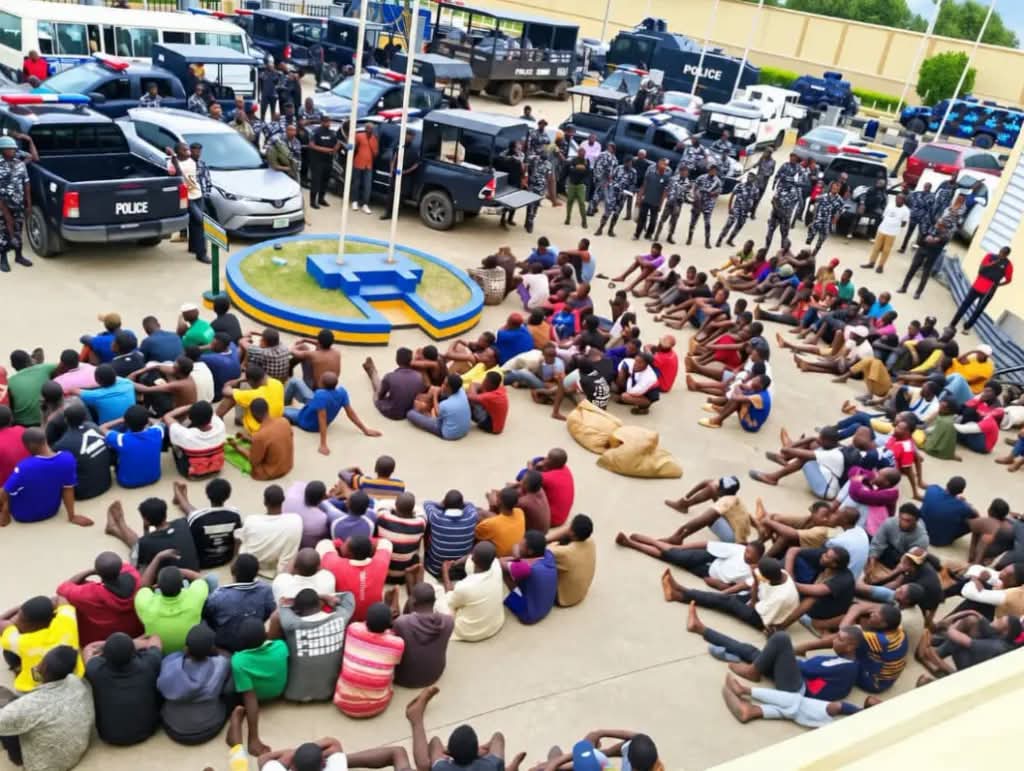
The Federal Capital Territory (FCT) Police Command has detained approximately 300 persons for screening following a security operation carried out at locations identified as potential crime centres across Abuja.
The operation, conducted on Saturday, September 19, 2026, reportedly covered shanties, uncompleted buildings and other locations suspected of being used as hideouts by criminals.
The command said the exercise was aimed at preventing criminal activities, disrupting the operations of suspected offenders and strengthening security across the nation’s capital.
During the operation, police officers recovered several items, including knives, a toy firearm, cannabis and other substances suspected to be illicit drugs.
According to the FCT Police Public Relations Officer, Josephine Adeh, the individuals arrested are being screened and profiled to establish whether they have links to criminal activities.
The command explained that anyone found to have committed an offence would be prosecuted in accordance with the law, while those cleared of any wrongdoing would be released after the screening process.
The FCT Commissioner of Police, CP Ahmed Sanusi, said the command would continue with intelligence-driven raids and proactive policing, particularly in areas identified as possible criminal hideouts.
Sanusi also warned residents, particularly youths, about the dangers associated with illicit drug use. He noted that substance abuse can affect judgment and potentially contribute to violent or criminal behaviour.
He advised individuals struggling with drug-related problems to seek counselling and rehabilitation instead of allowing substance abuse to expose them or their communities to security threats.
The commissioner further instructed police personnel involved in the operations to maintain professionalism and operate strictly within the law.
He warned that officers must not use arrests or raids as opportunities to extort, intimidate or harass members of the public. According to him, any officer found demanding money unlawfully or engaging in other misconduct would face disciplinary measures.
The FCT Police Command subsequently appealed to residents to provide credible and timely information about suspicious activities and locations believed to be used as criminal hideouts.
-

 Social2 months ago
NAIS – Northern Nigeria/Abuja Chapter Honours Amb. Ebi Lagos with Award of Recognition
-
 Breaking3 months ago
2027: INEC Alegedly Announces Plans to Conduct Party Primaries in the Newly Created State Constituencies in Warri North and Warri Southwest LGAs, Others
-

 News1 month ago
PAP: EX-AGITATORS OF BOYLOAF CAMP DISTANCE SELVES FROM THEIR LEADERS ONSLAUGHT ON THE PAP ADMINISTRATOR
-

 Local News4 months ago
Just In: Ambassador Podoki Emerges APP Candidate for Burutu Constituency-I Assembly Seat
-

 Politics3 months ago
2027: Mulade Challenges NDC’s Substitution of His Party Candidacy, Demands ₦5 Billion Damages
-

 Breaking3 months ago
Tinubu Intervenes in Warri Delineation Dispute, Meets Ijaw, Urhobo and Itsekiri Leaders
-

 Local News4 months ago
INC: Group Faults Sponsored Attacks on Tompolo, Igbadiwei, Urges Unity in Ijaw Nation
-

 Entertainment2 months ago
JKing Logistics Coordinator Shed Light to Address Ijaw Music Wage Controversy